Science & Nature
It’s Open Mic Night on Chicago Rooftops, Where Acoustic Devices Will Listen for Migrating Birds
Back in 2019, a research study from the Cornell Bird Lab of Ornithology famously, or infamously, ranked Chicago as the “most dangerous city for migrating birds.”
Benjamin Van Doren contributed to that scientific paper and, in a full-circle moment, is now collaborating on a project to make the Windy City safer for the estimated 150 million to 200 million birds that wing their way over the city on their journeys north and south in the spring and fall.
The first step in protecting migrating birds, Van Doren said, is understanding how they use Chicago’s airspace. And that’s what brought him to the rooftop of Illinois Center on a blustery day in late April.
Now an assistant professor at the University of Illinois Urbana-Champaign, Van Doren was joined by his grad assistant Shu-Yueh “Winnie” Liao and J’orge Garcia, executive director of Windy City Bird Lab, as the three installed an acoustic monitor more than 350 feet above East Wacker Drive.
The device is the latest in a network that’s grown to 45 or 50 such monitors spread across the city (and a few suburbs). Garcia’s even installed one 111 stories up on the roof of the Willis Tower.
“I was more scared about whether they were going to let me do the project or not, so I didn’t have the time to be scared of the height,” he said.
The setups consist of a microphone, amplifier and credit-card-sized computer designed to record the calls of birds passing overhead at night, when most of North America’s migratory birds are on the move.
Because this nocturnal activity is nearly impossible to witness directly, “there’s a lot we don’t know about how migratory birds are navigating through a city like Chicago,” Van Doren said. “How do they contend with this urban jungle that we’ve created — from lights, to concrete to glass?”
Recorded audio is downloaded from the monitor nearly in real time and processed via Van Doren’s lab. Thanks to advancements in machine learning and computational power, birds can be identified at the species level by distinguishing their sounds. The results are shared on a publicly accessible dashboard.
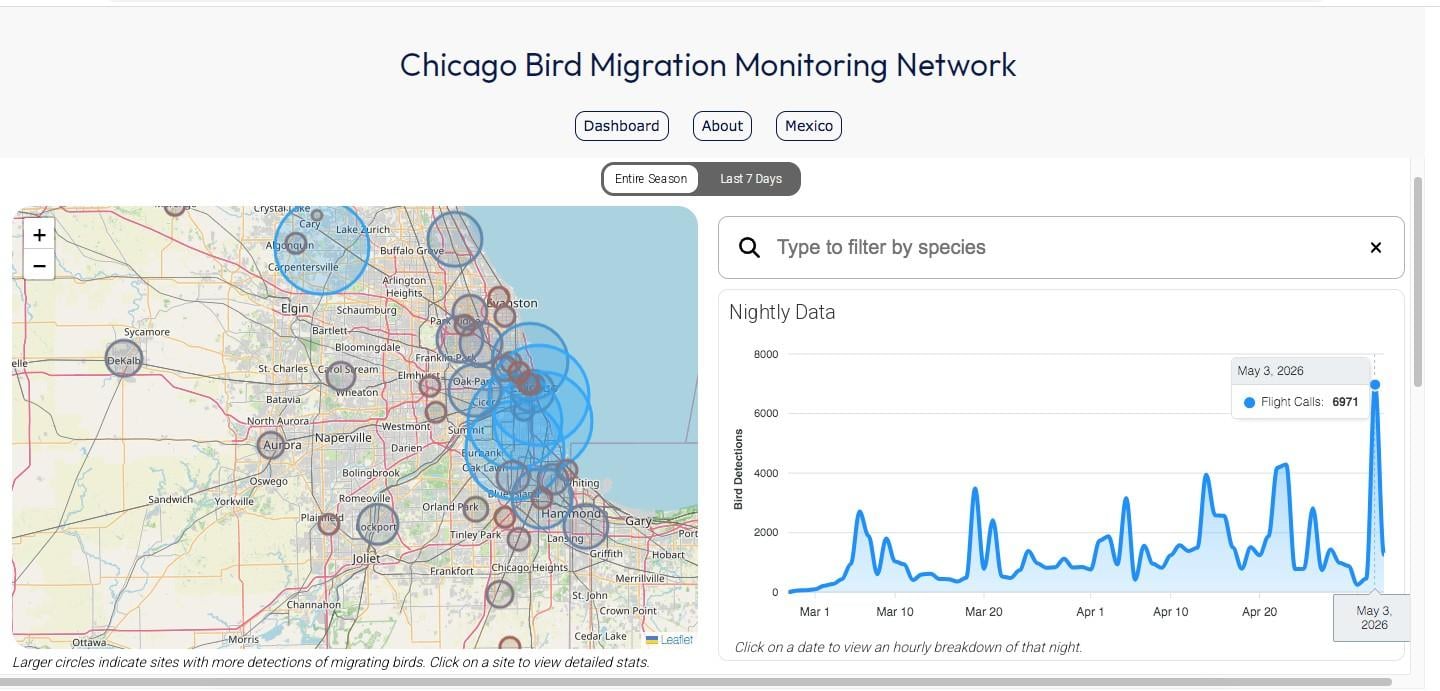 Information collected by acoustic monitors is fed into a publicly accessible online dashboard. (Chicago Bird Migration Monitoring Network)
Though people have been recording birds at night for decades, the monitoring network in Chicago is the first of its kind, according to Garcia.
“The way you would record these (in the past), you’d set up a battery-operated device for a couple of weeks, then you’d come back and you’d hope the data is there,” he said. “What we’ve been creating is a network where we can see that data live, see the dynamism of migration as it’s happening. We’re able to see exactly what is flying through.”
The team is also making use of additional monitoring techniques such as radar and thermal imagery to help round out the picture, gathering information such as the altitude at which the birds are flying, their velocity and direction. Are they moving toward the lake or inland? Are they being drawn off course by the city’s lights? Are they flying in unpredictable patterns that might indicate disorientation?
“This is an opportunity to see how they engage with our sky in a way that we haven’t been able to see before,” Garcia said.
Flyway City
Even on the kind of chilly overcast day that called for air quotes around the word “spring,” the view from the top of Illinois Center was undeniably spectacular. To the east, Lake Michigan spread out in an expanse of blue, while Willis Tower punched through the clouds to the west.
One of these landmarks represents what makes Chicago so attractive to migrating birds and the other what makes it so deadly.
A pair of exhibits set to open in June at the Chicago Architecture Center (located on the ground floor of One Illinois Center) will highlight that dichotomy. “Chicago’s Living Habitat,” co-curated with the conservation organization Openlands, puts the region’s diverse ecosystems and biodiversity on display, while “Flyway City,” co-curated by architect Jeanne Gang’s Studio Gang firm, explores the dangers Chicago’s buildings pose to birds — specifically collisions with glass windows — and the array of potential solutions.
“More than 1 billion birds every year are killed by colliding with glass they can’t see – that’s only in the U.S. — which is wild,” said Alissa Anderson, who heads up publications and exhibitions at Studio Gang.
While conservation groups and advocacy organizations have raised the alarm among their constituencies, Studio Gang has the potential to reach a different audience with the Architecture Center show.
“What we’re really excited to bring to it is an architecture and design and an artistic lens, to share a very clear, concise message about the issue,” Anderson said. “We hope the exhibition can be a platform to raise awareness about the importance of having requirements here in Chicago for bird-safe design.”
With a bird-friendly building ordinance currently stalled in Chicago’s City Council, the timing of the exhibits comes at a critical juncture.
Data from the newly installed Illinois Center rooftop acoustic monitor will feed into the exhibit, connecting the dots for visitors between what they’re viewing in the galleries and what’s happening in the sky above.
“It’s about adding more numbers and more facts to support bird-friendly policies,” Garcia said. “The more we can tell people and remind them that they’re birds are flying over and using our shared spaces, then the easier it will be to advocate for them.”
Unseen Ecosystem
") With a few claps of the hand, the team tests the acoustic monitor's microphone and data collection. The device atop Illinois Center will play a role in the upcoming "Flyway City" exhibit at the Chicago Architecture Center. (Patty Wetli / WTTW News)
With a few claps of the hand, the team tests the acoustic monitor's microphone and data collection. The device atop Illinois Center will play a role in the upcoming "Flyway City" exhibit at the Chicago Architecture Center. (Patty Wetli / WTTW News)
The monitoring network is already yielding some interesting results.
One bird that’s turned up regularly, acoustically speaking, is the upland sandpiper, a species of conservation concern given its rapidly declining numbers.
“We are capturing them flying over the city in numbers that we wouldn’t have expected, that you wouldn’t imagine, based on just how rare they are to see,” Garcia said.
Audio confirmation of the sandpiper’s presence not only tells researchers that Chicago’s airspace is important habitat for these birds, but it also suggests there’s an opportunity to perhaps coax some of them into settling down in one of the region’s restored grasslands.
“So, understanding the species moving overhead gives us a lot of information that we can apply to conservation,” Van Doren said.
The more stations that are added to the network and the longer the monitoring project runs, the more patterns will become apparent. Birds might be using previously unsuspected corridors, they might be more affected by certain weather conditions than others, there might be changes in the timing of specific species' migration, etc.
This information can then, in turn, be used to help inform decisions about where additional green space might beneficial on the ground, or where development might have a disproportionately adverse effect given its location along a popular flyway.
“The ultimate goal is to collate all of this and then make people more aware of what’s actually going on overhead,” said Van Doren. “If we can bring that unseen ecosystem to (people) and help them understand that Chicago is a city that has this amazing phenomenon of biodiversity moving through it, I think we’ll be better off.”
Note: This article was published May 6, 2026, and updated with video May 7, 2026.
Contact Patty Wetli: [email protected]